
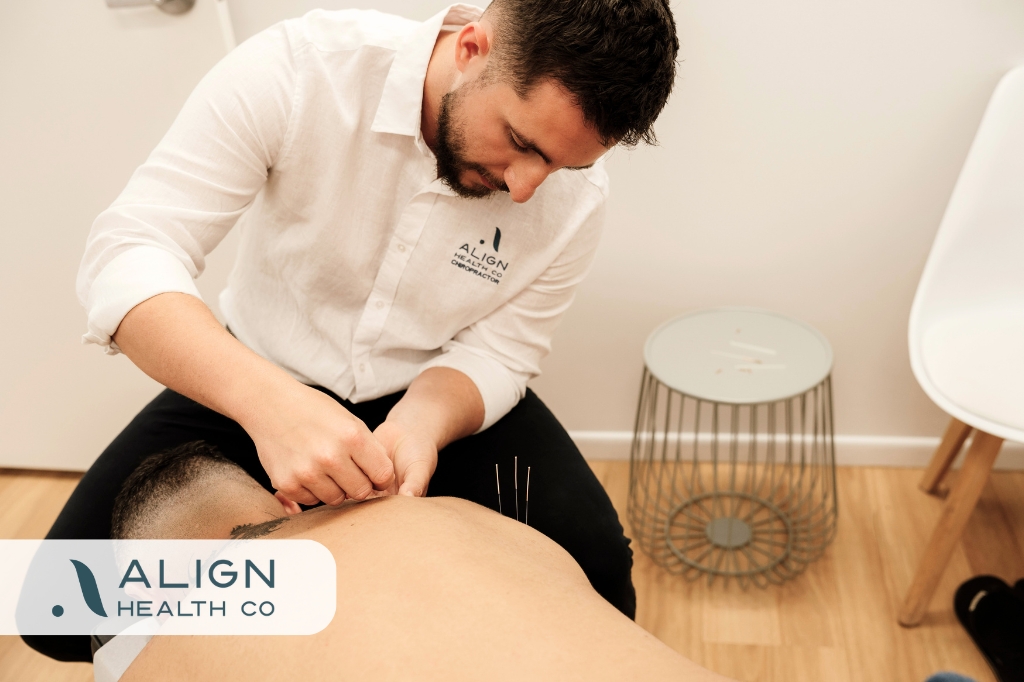
You’ve probably heard a mate at the gym or a colleague at smoko, mention dry needling. Maybe a physio or chiropractor has suggested it as part of your care plan, and you’ve nodded along while quietly wondering what the actual process involves. For someone who hasn’t been under a needle before, outside of a GP visit, the whole idea can sit somewhere between curious and off-putting.
This guide is for the reader who wants the plain version. Not the sales pitch. What dry needling actually is, how it works on muscle and joint function, what a session feels like, and the honest limits of what it can do. If you’re a miner coming off roster with a stiff lower back, a desk worker carrying tight shoulders, or an active adult trying to keep up with CrossFit, footy, or the odd round of golf, the answer below is written with your presentation in mind.
What Dry Needling Actually Is
Dry needling is a manual therapy technique where a very fine, sterile filament needle is inserted into specific muscle, tendon, or ligament tissue to release tension and support better movement. The word “dry” simply refers to the fact that nothing is injected. No medication, no fluid, no anaesthetic. The needle itself does the work.
At its core, the technique has three jobs in the body:
- It reduces tension in overactive, hypertonic muscle.
- It directs an inflammatory response into the treated area, which lifts blood flow and supports recovery.
- It improves joint mobility by releasing the muscles that act on that joint.
Those functions sound simple, and the mechanism is. What makes dry needling effective is precision: applying it to the exact tissue driving the problem rather than spraying technique across a general area.
How Dry Needling Works on Muscle and Joint Function
Most aches sitting in the neck, shoulder, hip, or lower back can be traced back to a small number of muscles running short and tight. When a muscle holds tension for long periods (think eight-hour computer sessions or hours of overhead work on site), it develops what are sometimes called trigger points. These are localised, cranky bands of fibre that pull on the joints nearby and change the way you move.
Inserting a needle into that specific band interrupts the signal. The muscle often gives a brief involuntary twitch when the needle finds the right spot. That twitch is the release. Once it has happened, the surrounding tissue starts to soften, blood flow increases, and the joint that muscle controls has more room to move freely.
For a lower back that has been compressed in a truck seat for 12 hours, that release can be the difference between spending day one of your week off on the couch and getting out fishing. For a neck that has been locked over a keyboard, it can mean the headaches settle without needing to reach for medication first.
Dry Needling vs Acupuncture: Clearing Up the Confusion
This is the question that comes up more than any other, and it’s worth answering properly because the two techniques are easy to confuse. The needles can look identical. The difference sits in the reasoning behind each approach.
Acupuncture is a traditional Chinese medicine practice built on the meridian system, a map of energy lines through the body. Points are chosen according to that system, and the technique is used for a wide range of systemic concerns.
Dry needling draws on a more modern understanding of muscle, tendon, and fascia. The targets are anatomical rather than energetic. A practitioner selects a specific muscle (say, the infraspinatus in the shoulder blade or the quadratus lumborum in the lower back) because that muscle is measurably contributing to the dysfunction you’ve walked in with. It is evidence-based care aimed at measurable results, which is why you’ll see it used widely in physio, chiropractic, and sports medicine settings.
Both can have value. They are two different tools answering two different questions.
What You’ll Actually Feel During and After a Session
The needles used in dry needling are very thin. For reference, you can fit nearly four of the 0.22mm needles we use inside the diameter of a standard blood-draw needle. Most first-time patients report the insertion as a light pinch at most. Many feel nothing at all.
When the needle reaches the right spot in a tight muscle, you may feel a brief twitch response or a dull, achy sensation. That’s the tissue releasing. Some patients describe it as satisfying in the same way a deep stretch is, and others find it odd the first time round. Both reactions are normal.
Afterwards, a mild soreness in the treated muscle for up to 24 hours is the most common feedback we get. It feels similar to the day after a decent workout. Drinking plenty of water helps the body clear the waste products moved through the muscle, and gentle movement is generally better than complete rest.
Safety, Risks, and the “No Go Zones”
Dry needling, performed by a trained practitioner, sits at the safer end of the manual therapy spectrum. That said, it isn’t risk-free, and any honest explanation of the technique needs to say so.
The most serious adverse events involve placing needles in anatomical areas with dense clusters of nerves, arteries, and veins (the groin, armpit, front of the neck, inside elbow, back of the knee) or near vital organs such as the lungs behind the ribs. Documented but rare risks include bleeding, bruising, transient nerve irritation, and in very rare cases a pneumothorax, where a needle reaches the pleural space around the lung.
This is why practitioner training matters. Our team completes formal training through CPD Health Courses, reviews techniques with each other multiple times a month, and works meticulously around high-risk zones rather than rushing. Needling should never be traded off against safety to save time.
Who Tends to Benefit Most
Three groups turn up in our rooms regularly and tend to respond well to dry needling as part of their broader care.
Miners and heavy machinery operators often present with deep lower-back tension after long rosters. Reducing that tension early in a break can shave days off the recovery window and give a real seven days off, rather than three days of pain followed by four of catching up on life.
Office and desk-based workers tend to show chronic neck, upper trap, and shoulder dysfunction from sustained computer time. Without intervention, this often progresses to more acute neck or shoulder pain and, over longer periods, joint wear. Needling these patterns early keeps the problem from settling in.
Active adults (gym-goers, CrossFitters, runners, footballers, weekend golfers) benefit in two ways. The release work reduces chronic tightness that limits range, and the blood flow response supports faster recovery between sessions. Plenty of our patients use it to stay in training rather than to get out of pain.
When Dry Needling Isn’t the Right Call
Dry needling is a tool, not a cure-all. It isn’t the right first step for everyone.
If the primary issue is a pinched nerve, a fresh ligament tear, a fracture, or an inflammatory condition that hasn’t been medically worked up, dry needling is either not indicated or needs to be timed carefully around other care. People on blood-thinning medication, people with certain bleeding disorders, and patients with a genuine phobia of needles that can’t be settled through education may be better suited to manual release techniques or soft tissue work instead.
A thorough assessment comes first. If needling isn’t the right answer for your presentation, we will say so.
What to Expect in Your First Session
Your first visit starts with a proper history and assessment, not a rushed ten minutes. We test through the whole region we suspect is involved. For a shoulder, that means looking beyond the rotator cuff into the deltoids, biceps, triceps, upper trap, and lats, because the muscle driving the problem isn’t always the one that hurts. That broader picture is what stops needling from becoming a cookie-cutter technique.
From there, we’ll talk you through the plan, show you the needles, and explain any sensation you should expect. At any point you can pause or stop the process. We use both 0.30mm and 0.22mm needles, with the thinner option available for anyone who is needle-sensitive.
Our chiropractic care is built around the idea that needling, adjustments, soft tissue work, and rehabilitation belong together rather than sitting in separate silos. The plan is tailored to what your body actually needs.
Dry Needling: Your Questions Answered
| Question | Answer |
|---|---|
| What is dry needling? | Dry needling is a manual therapy technique that uses very fine, sterile filament needles inserted into specific muscle, tendon, or ligament tissue. The aim is to release tension, lift blood flow, and improve joint mobility. Nothing is injected — the needle itself does the work. |
| Is dry needling the same as acupuncture? | No. The needles can look identical, but the reasoning is different. Acupuncture follows the traditional Chinese meridian system. Dry needling selects specific muscles based on modern anatomy and biomechanics to resolve measurable dysfunction, which is why it is used in physio, chiropractic, and sports medicine. |
| Does dry needling hurt? | Most patients report the needle insertion as a light pinch at most, and many feel nothing. When the needle reaches a tight band of muscle, a brief twitch or dull ache can occur as the tissue releases. Mild soreness similar to a post-workout feeling may last up to 24 hours. |
| Who tends to benefit most from dry needling? | Miners and machinery operators with lower-back tension, office workers carrying chronic neck and shoulder dysfunction, and active adults chasing faster recovery and better range of movement tend to respond well. A thorough assessment helps confirm whether dry needling is the right tool for your presentation. |
| Is dry needling safe? | In trained hands, dry needling sits at the safer end of manual therapy. Rare risks include bleeding, bruising, transient nerve irritation, and very rarely pneumothorax. Reputable practitioners maintain ongoing training, avoid high-risk anatomical zones, and adjust technique to each patient’s presentation. |
Final Thoughts
Dry needling is a precise, evidence-based technique with a clear job: restore function to overactive muscle and the joints it influences. Understanding the mechanism, the sensation, and the limits tends to settle most of the hesitation people carry into their first appointment. The best outcomes come from practitioners who assess thoroughly, treat the cause rather than only the site of pain, and build needling into a broader plan rather than using it as a stand-alone fix.
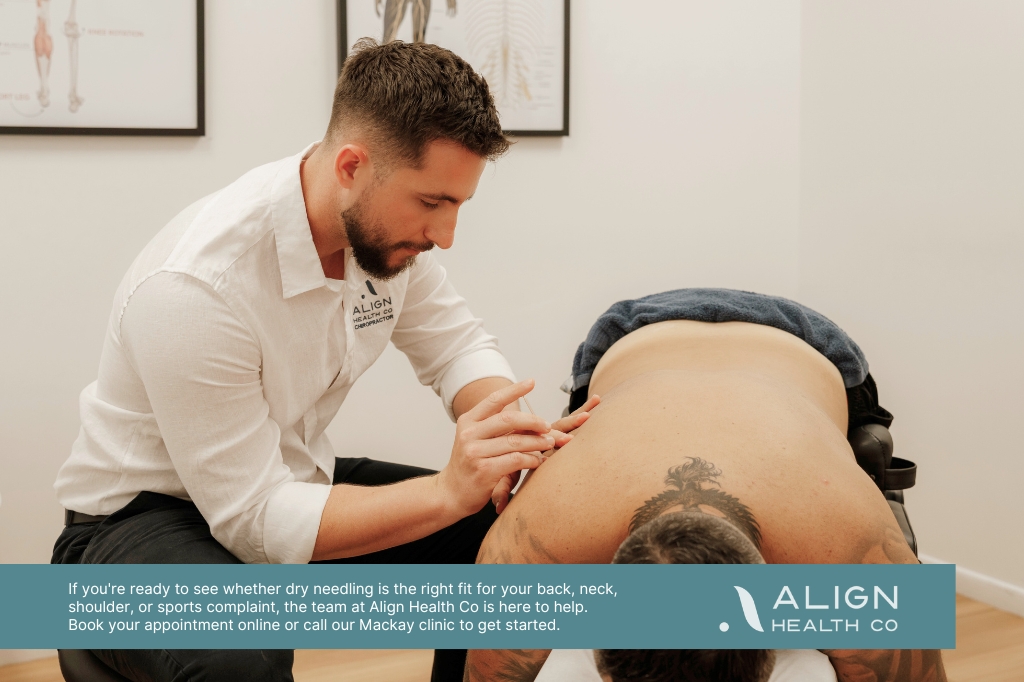
Been considering it for a while? The next step is a tailored assessment and having someone look at the specific pattern you’re dealing with. If you’re in Mackay and ready to see whether dry needling is the right fit for your back, neck, shoulder, or sports complaint, the team at Align Health Co is here to help.
Book an initial assessment and we’ll take the time to map out what’s actually driving your pain before recommending a plan. Book your appointment online or call our Mackay clinic to get started.