
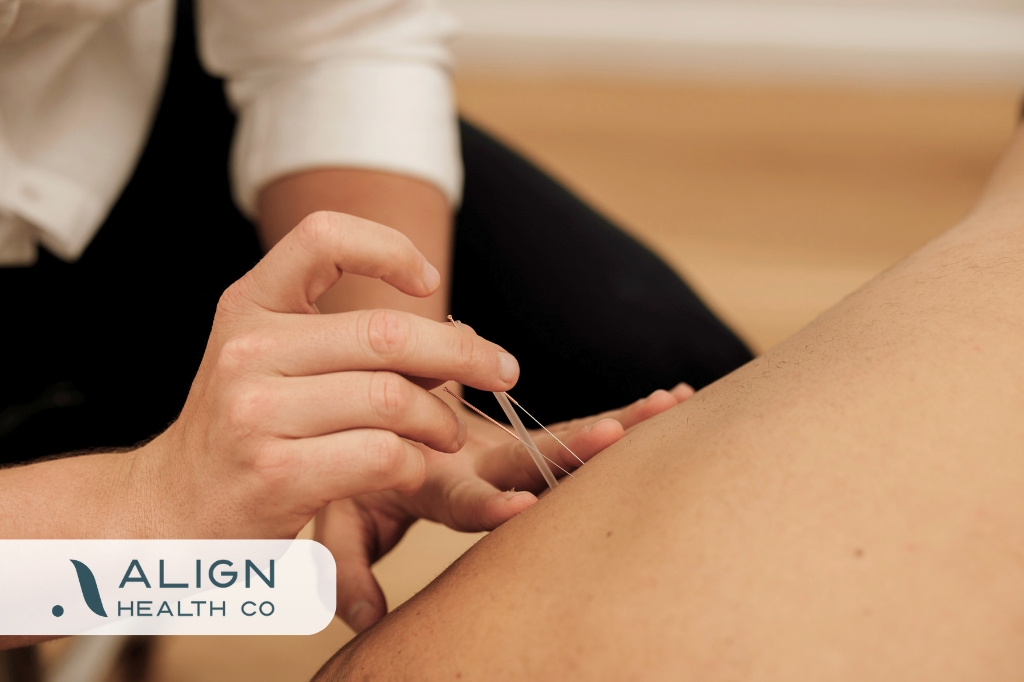
Dry needling is a therapy option we use in conjunction with chiropractic care to achieve greater results than what research suggests standalone therapies would typically achieve1. This means Chiropractic care doesn’t just have to be Chiropractic care! At Align Health Co we pride ourselves on using the best evidence-based practice. We covered what dry needling is HERE and what it can be used for.
Let’s take a closer look at headaches and dry needling. We commonly utilise dry needling therapy with headache cases as it has the capacity to improve either or both, joint range of motion or pain intensity. We’ll go through some information provided to us by a little literature-based information from studies that are at minimum Randomised controlled trials (Second best research format), though we primarily focus on Systematic reviews with Meta-analysis (Most informative study format!) for informing best clinical practice.
Why do we use Dry Needling?
It’s a safe, minimally invasive technique that when applied well, provides relief from symptoms, allowing us to use manual therapy and rehabilitation to create a comprehensive approach to manage patient health and help get back to doing Every Day, just a little bit better.
Dry needling initially provides an analgesic effect where we apply it, this means it allows pre-existing natural mechanisms in your body to help reduce pain without the aid of drugs2, 3. Beyond localised pain reduction we also know that Dry needling has high level evidence showing it could significantly improve headache frequency, health related quality of life, trigger point soreness and cervical range of motion in both tension type headache (TTH) and cervicogenic headaches (CGH)4.
In looking at TTH a common problem area is the sub occipital muscles, one double-blind randomised sham-controlled trial showed that dry needling therapy applied to the Obliquus Capitis Inferior muscle created immediate, short term clinically meaningful increase in C1/27. This area can be tough to effectively treat as direct pressure from massage or trigger point therapy can itself be quite uncomfortable.
How does it compare?
Typically, we steer away from comparing therapies as we believe different people will respond better with different modalities of care be it for the sake of comfort, confidence or simply preference. We do get asked on a regular basis, “How does it (Dry needling) compare to acupuncture?” Or “Should I also get acupuncture?”.
One systematic review and PRISMA-compliant meta-analysis showed dry needling to be superior immediately post-intervention when compared to acupuncture though by 12 weeks results appeared to be similar5. This considered, Dry needling provides statistically significant greater outcomes when combined with adjunct therapies such as manipulative therapy and physical therapy post treatment for pain reduction especially1. This makes it particularly suited to use in our practice where we are able to apply the most well-rounded care approaches for our patients.
What does it all mean?
In summary, dry needling is a safe and effective evidence-based modality to restore joint mobility and reduce muscle hypertonicity and muscle trigger points, especially in the cervical spine. It works through reducing neurotransmitter acetyl choline, increasing blood flow through physical interruption of a tissue causing a localised histamine response.
Dry needling is best used in conjunction with other modalities such as chiropractic care and yields better results through it. It allows for improvement in motion making rehab more effective and practical at earlier stages of care however dry needling therapy remains effective at the mid- and long-term marks both as a stand-alone treatment and as an adjunct modality.
References:
- Fernández-De-Las-Peñas, C., Plaza-Manzano, G., Sanchez-Infante, J., Gómez-Chiguano, G. F., Cleland, J. A., Arias-Buría, J. L., López-de-Uralde-Villanueva, I., & Navarro-Santana, M. J. (2021). Is Dry Needling Effective When Combined with Other Therapies for Myofascial Trigger Points Associated with Neck Pain Symptoms? A Systematic Review and Meta-Analysis. Pain research & management, 2021, 8836427. https://doi.org/10.1155/2021/8836427
- Navarro-Santana, M. J., Sanchez-Infante, J., Fernández-de-Las-Peñas, C., Cleland, J. A., Martín-Casas, P., & Plaza-Manzano, G. (2020). Effectiveness of Dry Needling for Myofascial Trigger Points Associated with Neck Pain Symptoms: An Updated Systematic Review and Meta-Analysis. Journal of clinical medicine, 9(10), 3300. https://doi.org/10.3390/jcm9103300
- Kietrys, D. M., Palombaro, K. M., Azzaretto, E., Hubler, R., Schaller, B., Schlussel, J. M., & Tucker, M. (2013). Effectiveness of dry needling for upper-quarter myofascial pain: a systematic review and meta-analysis. The Journal of orthopaedic and sports physical therapy, 43(9), 620–634. https://doi.org/10.2519/jospt.2013.4668
- Pourahmadi, M., Dommerholt, J., Fernández-de-Las-Peñas, C., Koes, B. W., Mohseni-Bandpei, M. A., Mansournia, M. A., Delavari, S., Keshtkar, A., & Bahramian, M. (2021). Dry Needling for the Treatment of Tension-Type, Cervicogenic, or Migraine Headaches: A Systematic Review and Meta-Analysis. Physical therapy, 101(5), pzab068. https://doi.org/10.1093/ptj/pzab068
- Hu, H. T., Gao, H., Ma, R. J., Zhao, X. F., Tian, H. F., & Li, L. (2018). Is dry needling effective for low back pain?: A systematic review and PRISMA-compliant meta-analysis. Medicine, 97(26), e11225. https://doi.org/10.1097/MD.0000000000011225
- Liu, L., Huang, Q. M., Liu, Q. G., Thitham, N., Li, L. H., Ma, Y. T., & Zhao, J. M. (2018). Evidence for Dry Needling in the Management of Myofascial Trigger Points Associated With Low Back Pain: A Systematic Review and Meta-Analysis. Archives of physical medicine and rehabilitation, 99(1), 144–152.e2. https://doi.org/10.1016/j.apmr.2017.06.008
- Murillo, C., Treleaven, J., Cagnie, B., Peral, J., Falla, D., & Lluch, E. (2021). Effects of dry needling of the obliquus capitis inferior on sensorimotor control and cervical mobility in people with neck pain: A double-blind, randomized sham-controlled trial. Brazilian journal of physical therapy, 25(6), 826–836. https://doi.org/10.1016/j.bjpt.2021.07.005

Bringing It All Together: Evidence-Informed Care for Headaches and Neck Pain
Dry needling has emerged as a valuable, evidence-based tool in the management of headaches and neck pain, particularly when guided by current research and applied with clinical expertise. As explored throughout this article, it offers meaningful benefits—from reducing pain and muscle tension to improving cervical range of motion and overall quality of life. Importantly, the literature consistently highlights that while dry needling is effective on its own, its true strength lies in being part of a broader, integrated care approach.
At Align Health Co, this is exactly how we approach treatment. By combining dry needling therapy with chiropractic care, manual therapy, and tailored rehabilitation strategies, we aim to deliver well-rounded, patient-centred outcomes that go beyond short-term relief. If you’re experiencing headaches or neck pain and are looking for a treatment approach grounded in research and personalised care, our team is here to help.
